
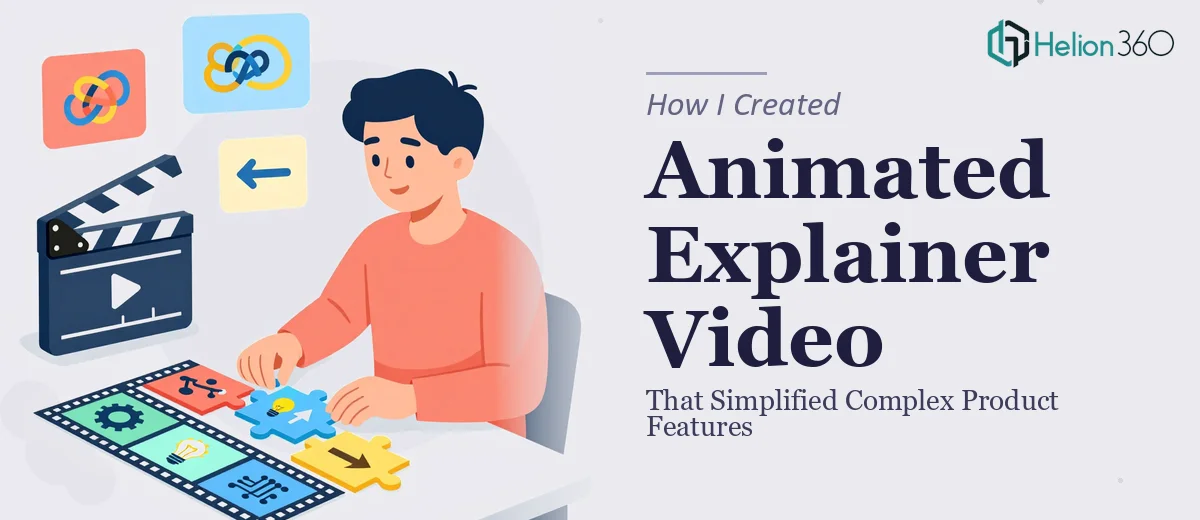
The Product Was Great. Explaining It Was the Problem
We had a product that genuinely solved a hard problem. The team understood it deeply, the roadmap was solid, and the early feedback from users was strong. But every time we needed to communicate how it worked — to a new audience, at an event, on a landing page — we fell flat. People nodded politely and moved on. The complexity of the product was getting in the way of the story.
The ask was clear enough on paper: create an animated explainer video that walks viewers through what the product does and why it matters, in a way that feels approachable and leaves them wanting to know more. But I knew almost immediately that this wasn't a task I could hand to someone with a template and a free animation tool. The stakes were real. This video would represent the product across every platform we touched — sales calls, social, the website. It needed to be right.
What I Found Out This Kind of Work Actually Involves
I started looking into what a well-executed animated explainer video actually requires, and the scope became clear fast. This isn't just motion design layered on top of a script. The work starts much earlier and goes much deeper.
The first thing that stood out was the narrative architecture. The script has to do a very specific job: take something unfamiliar and build comprehension in under two minutes. That's a craft problem before it's ever a visual one. Getting the message hierarchy right — what you say first, what you leave out, how you pace the reveal — takes real expertise in persuasive structure.
The second thing was visual language consistency. Every character, icon, color, and motion style has to feel like it belongs to the same world. A mismatch anywhere — a slightly off-brand color, an animation timing that doesn't match the voiceover rhythm — and the whole thing starts to feel amateurish.
The third signal that this was serious work: platform optimization. A video that works on a website doesn't automatically work as a social clip or a sales leave-behind. Each format has different dimension requirements, pacing expectations, and even caption and audio-off considerations. That's a layer of production planning most people don't think about until it's too late.
What the Production of a Good Explainer Video Actually Requires
The work starts with a structural audit of the message. A proper explainer script runs 150–180 words per minute of finished video, which means a 90-second video is roughly 225 words — every one of them doing load-bearing work. The right approach involves mapping a clear problem-solution-benefit arc before a single frame is storyboarded. This means stripping the product narrative down to its essential logic: what pain exists, how the product addresses it, and what the viewer's life looks like after. Getting this wrong at the script stage means every subsequent production effort compounds the error, and revisions after animation has started are expensive in both time and coherence.
Visual mechanics in animation are governed by rules that aren't obvious until you've built a lot of them. A consistent motion style means defining easing curves, animation durations (typically 200–400ms for UI transitions, 600–800ms for scene changes), and a type hierarchy (usually a 48pt/32pt/20pt scale for title, supporting copy, and labels). Character or icon consistency requires a shared design system — same stroke weight, same corner radius, same spatial logic across every asset. The execution friction here is significant: building even a modest 20-scene explainer with 15–20 unique illustrated assets and frame-accurate animation timing takes dozens of hours for a practitioner who already has the system in place.
Polish and cross-platform delivery are where a lot of otherwise solid explainer videos fall apart in the final stretch. Proper delivery involves exporting master files at 1920×1080 for web, cut-down versions at 1080×1080 and 9:16 for social, and ensuring the visuals communicate clearly at low volume or mute — which means caption integration and icon-forward design choices from the start. Encoding specifications matter too: wrong bitrate or codec choices degrade visual quality on certain platforms in ways that aren't visible until after upload. Doing this well requires platform-specific knowledge that only comes from having delivered across these formats repeatedly.
Why I Brought Helion360 in to Handle the Full Project
Once I understood the scope — the scripting discipline, the visual system requirements, the platform delivery complexity — it was obvious this wasn't something to figure out in real time under a deadline. I needed a team that already had the process built, the asset systems ready, and the delivery experience in place.
Helion360 handled the project end-to-end: script development and narrative structure, full illustration and motion design, and final delivery across all required formats. What would have taken me weeks of coordination and iteration — just to reach a competent baseline — was turned around quickly. The storyboard went through a focused review cycle, the animation was built on a consistent visual system from day one, and the final assets arrived ready to deploy across platforms without additional production work on our end. That kind of full execution, delivered fast, is exactly what the project needed.
What the Video Actually Did — and What I'd Tell Anyone in My Position
The finished video did what no slide deck or live demo had managed to do: it handed viewers a mental model of the product in under two minutes. Conversations changed after people watched it. The sales team started leading with it. The website conversion on the product page measurably improved. And because the visual language was built with consistency from the start, adapting it for social cuts and internal training was straightforward — the system was already there.
If you're sitting on a product that deserves a clearer introduction to the world and you're realizing, as I did, that the work involved is deeper than it looks from the outside — Helion360 is the team to engage. They handle this kind of project end-to-end and deliver fast, without the weeks of ramp-up time you'd otherwise spend learning the craft from scratch.