When Polished Documents and Branded Slides Both Need to Be Right at the Same Time
I had a situation that felt manageable on paper — edit a batch of documents and produce a matching set of Canva slides. Both needed to go out to an external audience, and both needed to feel like they came from the same professional operation. The documents carried substantive content that had to be clean, grammatically tight, and consistently formatted. The slides needed to look like they belonged to the brand — not like someone eyeballed the colors and picked a font that seemed close enough.
The deadline was real. The audience was external. And once I started mapping out what doing this properly actually required, it became clear this wasn't something I could squeeze into spare hours between other priorities. Getting it wrong would mean documents going out with inconsistencies that undermine credibility and slides that look slightly off-brand — both of which send exactly the wrong signal to the people receiving them.
What I Found the Work Actually Required
I assumed document editing was mostly a grammar pass. It isn't — not at a professional standard. Done well, it involves a full editorial review: grammar, yes, but also sentence-level clarity, structural consistency across sections, heading hierarchy, consistent use of terminology, and formatting rules that hold across the entire document rather than just individual paragraphs.
The Canva slides layer added a separate skill set. Producing slides that genuinely align with brand guidelines means working from a defined palette, respecting type hierarchies, maintaining consistent spacing and layout logic across every slide — and making deliberate graphic design decisions, not just dragging elements into place and hoping it looks right.
Three things signaled the real complexity here. First, the two workstreams — documents and slides — had to feel cohesive, which meant decisions made in one had to inform the other. Second, brand consistency at the slide level requires knowing what to do when a template doesn't quite fit the content. Third, the volume of detail across multiple documents and multiple slides means that without a disciplined workflow, inconsistencies accumulate faster than they can be caught.
What the Execution Actually Looks Like at This Level
The editorial work on the documents starts with a structural audit — reading for logic and flow before a single grammar correction is made. Proper editing follows a hierarchy: first addressing content-level issues (unclear arguments, missing transitions, structural gaps), then formatting consistency (heading levels, bullet parallelism, spacing rules), and finally a close proofread for grammar, punctuation, and typo-level errors. Skipping the structural pass and going straight to proofreading is the most common mistake, and it results in documents that are grammatically clean but still confusing to read. Maintaining that sequence across multiple documents, each with its own structure and subject matter, takes methodical discipline and real time investment.
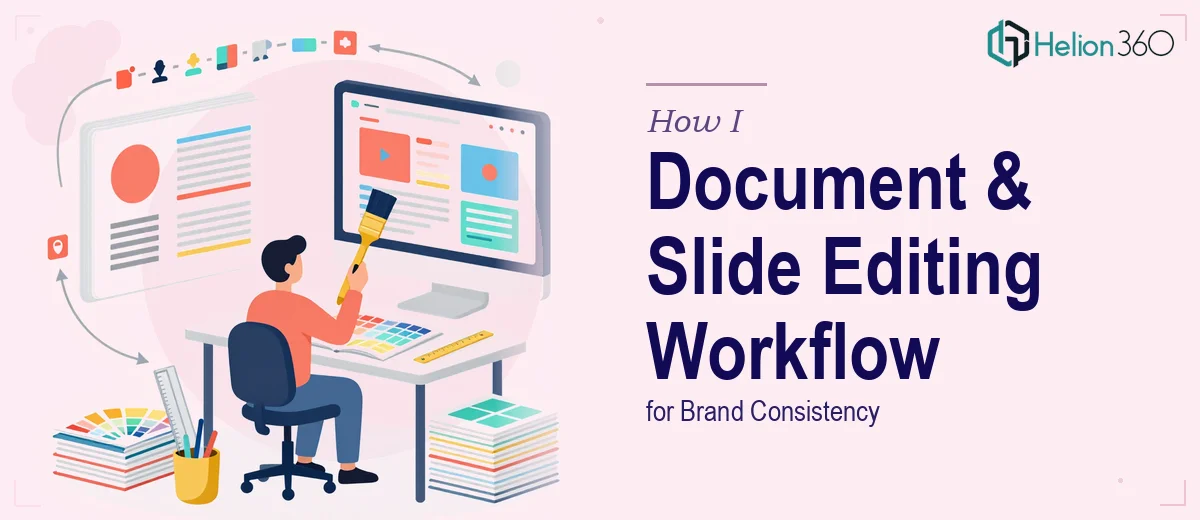
The Canva slide work involves a different kind of precision. Proper branded slide design starts from a defined visual system: a maximum of four brand colors applied with clear hierarchy, a type scale that typically runs at three levels (a headline size, a body size, and a supporting caption size — roughly 36pt, 24pt, and 16pt equivalents), and a consistent layout grid that determines where content sits on every slide. In Canva specifically, setting up brand kit elements and applying them with discipline across a multi-slide deck takes significantly longer than it looks from the outside. The edge cases — slides where content volume breaks the standard layout, or where an image needs to coexist with text without compromising legibility — require genuine graphic design judgment, not just template selection.
The consistency layer is where both workstreams converge and where the most invisible work happens. Terminology used in the documents should match language on the slides. Visual tone should feel unified. If a document uses a particular term for a concept, the corresponding slide shouldn't use a different one. Catching these cross-material inconsistencies requires someone who is reviewing both outputs simultaneously against a shared standard — not two separate people working in isolation. That coordination overhead alone adds meaningful hours to the project and requires clear communication throughout.
Why I Brought Helion360 in to Handle the Full Project
Once I understood what doing this well actually required, I wasn't interested in attempting it myself or managing a fragmented process across different people. I needed both workstreams handled cohesively, quickly, and to a professional standard — and I needed someone who already had the workflow for exactly this kind of project.
Helion360 handled the full scope end-to-end: the editorial passes on all documents, the Canva slide design built to brand, and the consistency review across both outputs. They turned it around quickly — done in days, not the weeks it would have taken me to work through the learning curve on the slide design side alone, let alone coordinate the editorial and visual work simultaneously. The communication throughout was clear, the feedback loop was tight, and nothing fell through the gap between the document work and the slide work because it was all managed as a single project by a team that does this all day.
The Outcome and What I'd Tell Anyone in My Spot
What came back was a set of documents that read cleanly and consistently, and a set of Canva slides that looked like they were made by someone who actually understood the brand — because the design decisions were deliberate, not improvised. The two outputs felt like they came from the same place, which was the point. The materials went out on time, and the external audience received something that reflected the standard the content deserved.
If you're looking at a similar combination of document editing and branded slide design and you want it handled end-to-end without the coordination overhead or the learning curve, Helion360 is the team to engage — they delivered fast, managed both workstreams as one, and brought the kind of execution depth this work genuinely requires. Learn more about the workflow for converting documents into presentations to understand what professional execution actually involves.