
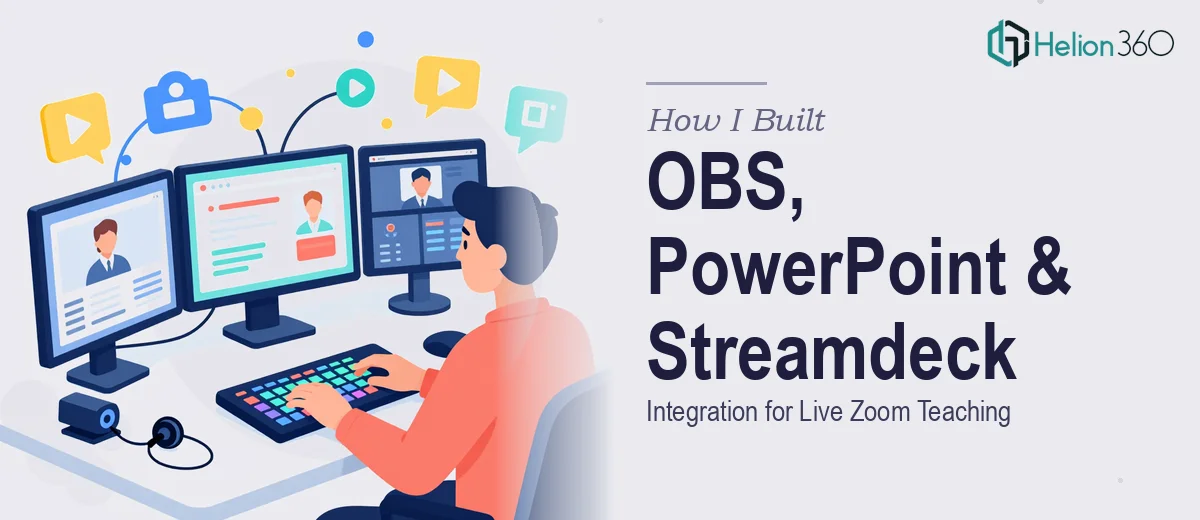
When I decided to move my classes fully online, I assumed the hardest part would be the content. I had my slides ready, a decent microphone, and a reliable internet connection. What I did not account for was how complicated it would be to get OBS, PowerPoint, and a Streamdeck all talking to each other inside a live Zoom session.
The Setup I Was Going For
My goal was straightforward on paper. I wanted to use OBS as a virtual camera so I could control exactly what my students saw on screen — switching between my slides, my face, a whiteboard overlay, and a branded intro screen. The Streamdeck was supposed to make those switches instant, with one button press per scene. PowerPoint would run in the background, and OBS would capture it and push it into Zoom as a clean, professional feed.
Simple enough in theory. In practice, it became a tangle of settings, scene collections, window capture issues, and audio routing problems that ate up two full evenings.
Where It Started Breaking Down
The first problem was getting OBS to correctly capture PowerPoint without the slides flickering every time I clicked to the next one. I tried window capture, then display capture, then a game capture mode that someone on a forum suggested. Each had a different tradeoff — one dropped frames, another showed my desktop wallpaper during transitions, and the third refused to work at all when PowerPoint was in presenter view.
The Streamdeck side was its own challenge. Mapping buttons to OBS scenes worked, but the logic of what should trigger when was harder to think through than I expected. And when I finally got into a Zoom test call, the virtual camera feed looked washed out and the audio was routing through the wrong device entirely.
I was spending time I did not have on technical troubleshooting instead of preparing my actual lessons.
Getting the Right Help
After hitting a wall, I came across Helion360. I explained the full picture — the OBS virtual camera setup, the PowerPoint slide capture issue, the Streamdeck scene switching, and the Zoom integration — and their team took it from there.
What helped was that I did not have to explain everything from scratch. They understood the workflow immediately and asked the right questions: What version of OBS? Was I using presenter view or slideshow mode? Did I need the Streamdeck to also control audio muting inside Zoom? That level of clarity told me they had worked through this kind of multi-tool setup before.
What the Final Setup Looked Like
The solution they put together was clean and genuinely easy to operate during a live class. OBS was configured with a dedicated scene collection for teaching — one scene for full-screen slides, one for a picture-in-picture layout with my webcam, one for a blank branded holding screen between sessions, and one for screen sharing when needed. PowerPoint was set to run in windowed slideshow mode, which eliminated the flickering issue entirely and made the OBS window capture stable.
The Streamdeck was mapped logically — the top row for scene switches, a dedicated button for muting the mic, and one button that triggered a countdown overlay I could use at the start of each class. Everything was labeled clearly so I was not hunting for the right button mid-session.
Zoom was set to use the OBS virtual camera as its video source, and the audio routing was corrected so my microphone fed cleanly without any echo or doubling. The first real class I ran with the setup felt noticeably more professional, and students commented that the transitions between slides and camera views were smooth.
What I Took Away From This
Integrating multiple tools like OBS, PowerPoint, and a Streamdeck into a single live teaching workflow is not something you can figure out in an afternoon if you are doing it for the first time. The individual tools are not complicated on their own — it is the interaction between them, and the specific demands of a live Zoom environment, that makes it genuinely tricky.
Having someone who understood both the technical side and the practical demands of live teaching made a real difference. The setup I ended up with is one I can actually maintain and adjust on my own going forward.
If you are trying to build a similar remote teaching or live presentation setup and keep running into the same configuration problems, Helion360 is worth reaching out to — they handled the complexity I could not crack and delivered a professional PowerPoint presentations setup that just works. For teams managing these kinds of integrations, PowerPoint Formatting Services can ensure your slide output is polished across all scenes. You might also find it helpful to explore how others have solved automatic conversion of data to PowerPoint for streamlined workflows.